What is neurodiversity?
Overview
Understanding different minds
The term was coined by sociologist Judy Singer in 1998. Neurodiversity refers to the natural variation in human brains. Just as biodiversity describes diversity in ecosystems, neurodiversity recognises diversity in thinking, learning, attention, communication, social interaction, movement, and sensory experiences.
Neurodivergent thinking
Neurodivergent describes people whose cognitive styles differ from dominant societal expectations. Common examples include autism, ADHD, dyslexia, dyspraxia, dyscalculia, Tourette syndrome, and OCD. Many appear in the DSM-5, but the neurodiversity framework emphasises difference, not deficit.
Why this matters
Historically, cognitive differences were framed mainly as mental illness, intellectual disability, or developmental disorder. Neurodiversity reframes these differences as natural neurological variation, experiences shaped by social environments, and a mix of strengths and challenges.
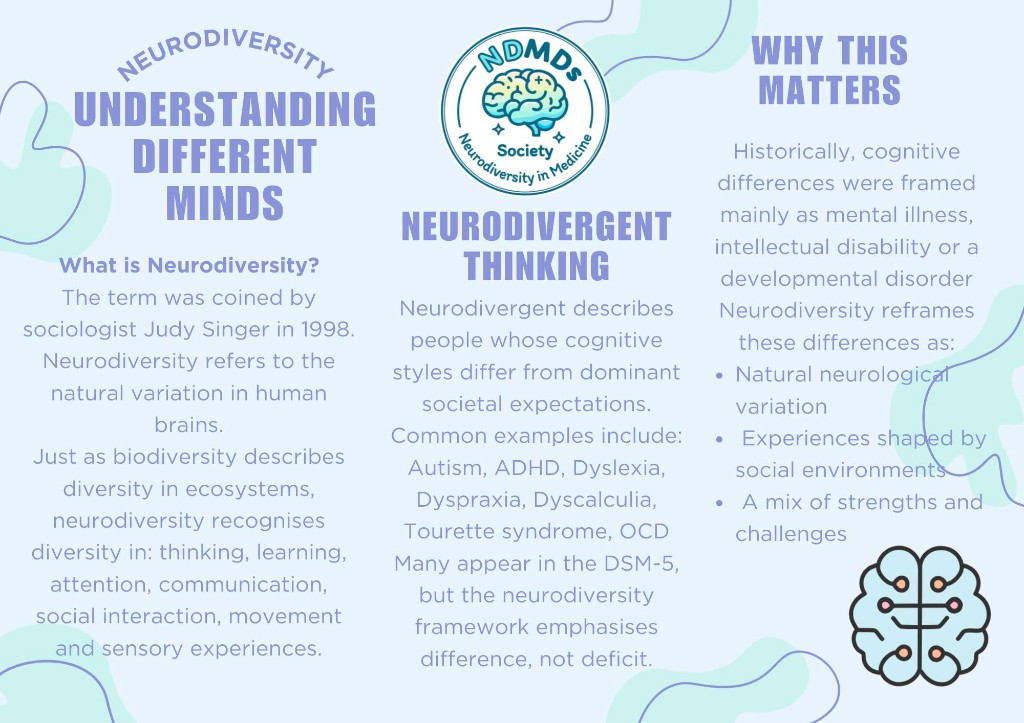
Lived experience
For many people, recognising neurodivergence can be:
- A moment of clarity, where past experiences suddenly make sense.
- A pathway to meeting others who share similar experiences.
- Emotionally complex — with relief, pride, uncertainty, or stigma, sometimes all at once.
Neurodiversity reminds us that different brains are part of normal human variation. Social structures shape whether differences become barriers; only understanding diversity improves inclusion.